| Squint – Strabimus |
 |
|
|
| |
 |
What is it? |
| |
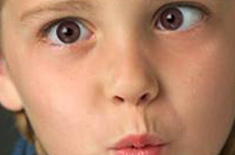
A squint, also known as strabismus is a condition in which the eyes do not align
properly, one of them turns inwards, upwards, downwards, or outwards while the
other one focuses at one spot. Typically, the extra ocular muscles are not working in
coordination, resulting in each eye unable to gaze at the same spot at the same time. |
|
What Causes it? |
| |
The exact cause of a squint is not always known. In most cases, babies are born
with a squint or develop one due to a problem with their vision.
If a baby is born with the condition, it is called a congenital squint. Squints that develop
later are called acquired squints.
Refractive errors
Acquired squints are sometimes caused by the eye’s inability to focus light that passes
through the lens. This is known as a refractive error. Types of refractive errors include:
• short-sightedness (myopia) - a sight problem that affects your ability to see distant
objects
• long-sightedness (hyperopia) - a sight problem that affects your ability to see
close-up objects
• astigmatism - where the cornea at the front of the eye is unevenly curved, which
causes blurred vision
If a child has a refractive error, their eye may turn inwards or outwards as it attempts to
focus. Squints caused by refractive errors usually develop in children aged two years or
older. They tend to be most common in children who are long-sighted. Although most
squints are congenital or caused by refractive errors, in rare cases they are the result of:
• childhood illnesses, for example viral infections such as measles - although it
is possible these illnesses simply accelerate a squint that would have developed
anyway
• some genetic conditions - such as Down syndrome
• hydrocephalus, caused by a build-up of fluid in the brain
• other eye problems, such as abnormal development of the muscles that move the
eye, or a problem with the retina (the layer of light-sensitive nerve cells at the
back of the eye. |
|
Who are at risk? |
| |
Some things may increase the risk of a child having a squint, including:
• having a family history of squints, lazy eye (amblyopia) or needing glasses
• having a condition that affects the nervous system, such as cerebral palsy
• being born early (prematurely) or with a low birth weight . |
|
What are the symptoms & signs? |
| |
Most obvious sign of a squint is eyes that look in different directions.
Most often, one eye turns inwards (convergent squint) or outwards (divergent squint). In
rarer cases, it may turn up or down (vertical squint).
Squints can also be apparent at all times (constant), or only be apparent at certain times
(intermittent). Minor squints are not always obvious.
Symptoms of squint :
Double vision , Crossed eyes , Uncoordinated eye movements , Favoring a head position. |
|
How is it diagnosed? |
| |
During eye examination, a test which is called cover test, is typically used in the
diagnosis and measurement of strabismus. If the eye being tested is the strabismic eye,
then it will fixate on the object after the "straight" eye is covered, as long as the vision
in this eye is good enough. If the "straight" eye is being tested, there will be no change
in fixation, as it is already fixated. Depending on the direction that the strabismic eye
deviates, the direction of deviation may be assessed. Exotropic is outwards (away from
the midline) and esotropic is inwards (towards the nose); these are types of horizontal
strabismus. "Hypertropia" is upward, and "Hypotropia" is downward; these are types of
vertical strabismus, which are less common.
A simple screening test for strabismus is the Hirschberg test. A flashlight is shone in the
patient's eye. When the patient is looking at the light, a reflection can be seen on the front
surface of the pupil. If the eyes are properly aligned with one another, then the reflection
will be in the same spot of each eye. Therefore, if the reflection is not in the same place
in each eye, then the eyes are not properly aligned.
Strabismus may be classified as unilateral if the one eye consistently deviates, or
alternating if either of the eyes can be seen to deviate. Alternation of the strabismus may
occur spontaneously, with or without subjective awareness of the alternation. Alternation
may also be seen following the cover test, with the previously examined eye remaining
straight while the previously straight eye is now seen to be deviated on removal of the
cover. The cover-uncover test is used to diagnose the type of strabismus present.
Strabismus may also be classified based on time of onset, either congenital, acquired, or
secondary to another pathological process, such as cataract. Many infants are born with
their eyes slightly misaligned. The best time for physicians to assess this is between ages
3 and 6 months. |
|
What is the treatment? |
| |
It is important that a squint is treated as soon as possible after being detected.
If it is not treated, vision problems, such as those caused by a lazy eye (amblyopia), are
likely to get worse or could become permanent.
Treatment is most effective in very young children.
Several types of treatment are available for squints, including:
• glasses
• eye exercises
• botulinum toxin injections
• corrective surgery . |
|
What are the surgical options? |
| |
If other treatments are unsuccessful, surgery may be needed to correct a squint.
Surgery can be used to:
• improve the alignment of the eyes (and therefore their appearance)
• help the eyes work together
Surgery involves moving the muscles attached to the outside of the eye to a new position.
It may be necessary to operate on both eyes to balance them, even if the squint is only in
one eye.
The operation is carried out under general anaesthetic and usually takes less than an hour
to perform. It is often carried out as a day case. During the operation, patients eye will
be kept open using an instrument called a lid speculum. The ophthalmologist (eye care
specialist) will detach one part of the muscle that is connected to patients eye and will
either move it backwards to weaken the pulling effect or shorten it to increase the pulling
effect. Once the correction has been made, the muscles will be sewn back into place
using dissolvable stitches. |
|
What are the outcomes? |
| |
For amblyopia: it is important that the condition is treated during childhood in
order to improve vision quicker. Early treatment will also increase chances of a normal
vision. If the treatment is administered when the child is old, vision can be improved but
not fully-restored.
For improvement of appearance: surgery is usually done to straighten the eyes. In some
cases, two operations are necessary to fully-straighten the eyes. There are also cases
when the squint returns years after the successful surgery. If this happens, another
operation will be done.
|
|
What are the complications? |
| |
If child’s squint is left untreated, there is a risk that his or her binocular single
vision (BSV) may not develop properly. BSV is important because it allows the child to
see a single image, even though each eye will ordinarily pick up slightly different images.
BSV helps the child to see the world in three dimensions.
When the child looks at something both eyes pick up an image. These images are then
sent to the brain where they are turned into one image. Each image provides slightly
different information about the object enabling the child to interpret depth (the ability to
judge the distance between objects). BSV develops during childhood. If the eyes don’t
face in the same direction together during this time, BSV can't develop properly and the
child's vision may never develop fully.
Untreated squints also carry the risk of a lazy eye (amblyopia) developing. When the eyes
aren't aligned, the images picked up by each eye are too different for the brain to combine
into one image. To overcome this, the brain starts to ignore one of the images so that a
clear picture is seen from one eye only. The eye that is ignored is called sometimes called
a lazy eye. If the affected eye isn’t treated, it can prevent the brain developing vision for
that eye. |
|
What is the time course? |
| |
The earlier a child develops a squint and the later it can be treated by a doctor,
the worse the visual impairment will be. By the time the child reaches school age, the
prospects of successful treatment decline dramatically. Babies and small children with
a squint should be treated at the earliest possible moment. Regular follow-ups visits are
required as advised by an specialist. |
|
What is the expense? |
| |
The expense depends upon the grades of treatment. |
|
| |
Author: Dr. Sanjay Dhawan
Last Updated on: 1 March, 2014 |
| |
|
|
|



